So, after a comment that my previous background--the one with all the books--made the text hard to read, I went on a rampage of renovating this blog including font changes, color changes, and a new page of links in which I put all (or most) of the links that I put in my normal posts along with other links that I think are noteworthy, yet not important enough to have their own blog post, with short blurbs about them. (If you can't tell, I really like green.)
19 February 2011

18 February 2011
On Hell and Who Gets to Go There

The question was this: Is Hell exothermic (gives off heat) or Endothermic (absorbs heat)?
Naturally, most people answered the question with a simple combination of their religious beliefs and Boyle's law; however, one answered with this: "First, we need to know how the mass of Hell is changing in time. So we need to know the rate that souls are moving into Hell and the rate they are leaving. I think that we can safely assume that once a soul gets to Hell, it will not leave. Therefore, no souls are leaving. As for how many souls are entering Hell, let us look at the different religions that exist in the world today. Some of these religions state that if you are not a member of their religion, you will go to Hell. Since there are more than one of these religions and since people do not belong to more than one religion, we can project that all souls go to Hell. With birth and death rates as they are, we can expect the number of souls in Hell to increase exponentially.
"Now, we look at the rate of change of the volume in Hell because Boyle's Law states that in order for the temperature and pressure in Hell to stay the same, the volume of Hell has to expand as souls are added. This gives two possibilities:
"1. If Hell is expanding at a slower rate than the rate at which souls enter Hell, then the temperature and pressure in Hell will increase until all Hell breaks loose.
"2. Of course, if Hell is expanding at a rate faster than the increase of souls in Hell, then the temperature and pressure will drop until Hell freezes over.
"So which is it?
"If we accept the postulate given to me by Teresa Banyan during my Freshman year, '...that it will be a cold day in Hell before I sleep with you.', and take into account the fact that I still have not succeeded in having sexual relations with her, then, #2 cannot be true, and thus I am sure that Hell is exothermic and will not freeze."
Receiving the only 'A' in the class, this student not only did something of reward but also opened the door to an important question: who is going to hell?
 The answer to this isn't simple or rational, nor does it make any sense to try to answer it, but, after all, we are only human, and humans are stubborn--no matter how much you tell them that they can't possibly find an answer to something, they still want to believe they are right. Silly humans.
Being the bookworm I am, I immediately found a similar example of this in Nathaniel Hawthorne's The Scarlet Letter. In the case that you haven't read this, it goes a little like this: (*spoiler alert*) Hester comes to America a few months before her hubby. She gets knocked up by a minister, and is, thus, forced to wear a red letter 'A' on her clothing by order of the Minister who screwed her in the first place. (Minister's aren't portrayed very nicely in this novel.) So about seven years later, after Hester's husband, a physician, has badgered the Minister into trying to confess to the affair with his wife, the Minister has decided to run away to Europe with Hester, and, just as they are about to step onto the boat to freedom (cosmic irony) from judgement, the Minister is all, "hold up! I confess! I Knocked up Hester seven years ago!" Then he dies. (*End of spoiler*)
The reason I brought up the example of The Scarlet Letter is because it shows perfectly that, although most may put the blame on those who are considered socially "unholy," we are nothing more than human. The Minister, although he put all of the blame on Hester, was just as guilty.
In Steven Sondheim's Into the Woods, the witch (played by Bernadette Peters) is the obvious source of all of the discontent of the other characters, but, arguably, the only one with real perspective. Towards the climax of the musical, while the characters who managed to survive the clumsy giant from the bean stalk who keeps stepping on people are deciding who is to blame, she finally sings:
No, of course what really matters is the blame, somebody to blame. Fine, if that's the thing you enjoy, placing the blame, if that's the aim, give me the blame.
 She acknowledges that people only want to find someone to blame, because, if they don't, it's safe to assume that it's their own fault, and people don't like to blame themselves. So she takes the blame.
Obviously not every person is going to hell, or there wouldn't be a heaven. Even if you don't believe that anything significant happens after death, it is mutually agreeable that people who point fingers are just as guilty as those they are blaming, (plus, they're really annoying.)
27 January 2011
On Office Supplies, Not Procrastinating, and Stupid Computers
Firstly, this post was originally entitled On Office Supplied and Not Procrastinating. Then my computer crashed. -_- Thankfully I didn't loose anything... except the almost 500 word draft of this post that I had typed. As a result of this, and the fact that I don't feel like retyping everything that I just spent the last thirty minutes working on, this post will be much shorter than 500 words.
 Secondly, I know I said in my last post that I was sorry that I hadn't posted anything in while and that I probably wouldn't be able to for a while do to my bad habit of procrastinating on homework and other school projects. However, there are rare instances where I somehow manage to get all or most of my homework done and still have a few moments to spare in my day to do something somewhat interesting. Today is one of those days, and this is my somewhat interesting thing.
Thirdly, I have an unnatural love of office supplies. It's really bad. I have several--five--pencil holders filled with pencils, markers, sharpies, highlighters, and other things of that sort, two notebooks, three journals, and an obnoxiously extensive collection of post-its.
It would not surprise me at all that if I had saved all of the money that I spend on office supplies, I wouldn't have to ask my grandma for gas money.
Fourthly, here is a video song by Lauren O'Connell and Ryan Lerman until my next post!
26 January 2011
On Procrastination
I am incredibly sorry to all five of my readers for not posting anything in almost a week, but with the accumulation of several school projects,--on all of which I have procrastinated,--I have not had much free time. This will probably change by February 11th when I get my life back.
In the mean time, here is a made-of-awesome video from one of my favorite channels on YouTube, Microrator.
Eet - Regina Spektor (cover by Microrator)
In the mean time, here is a made-of-awesome video from one of my favorite channels on YouTube, Microrator.
Eet - Regina Spektor (cover by Microrator)
22 January 2011
On Censorship
 Censorship is one of the few topics that really fires me up. The idea that someone thinks they have the right to tell someone they can't think something and express it because of some irrational system of societal rules is as irrational as the people who allow it to go on. The parents who don't allow their children to watch a television show or read a book because it might have questionable material or a few words here and there that they don't like have a clear misconception of what goes on in public schools. As much as the administrations of the public school system would deny it and try to suppress it, there are things that go on in schools that are far more shrewd than anything in these books.
 Two great examples of how people try their hardest to create some sort of over-protective dome of what they deem as 'appropriate' can be found here and here. The First of these links is a video from John Green whose book Looking for Alaska was being taught in a school where parents wanted it to be taken out of the curriculum. The Second is from a video blogger and author, Jackson Pearce, about the censoring of Mark Twain's The Adventures of Huckleberry Finn.
But, this blog is not about you or your parents or any one else who would want to censor it. It is about me and my thoughts. So to practice my powers of free speech, I chose the worst possible word in the English language; fuck--which for some reason is worse than other words that are deemed inappropriate. Below is a paragraph that I found here about the origins of the word fuck.
The obscenity fuck is a very old word and has been considered shocking from the first, though it is seen in print much more often now than in the past. Its first known occurrence, in code because of its unacceptability, is in a poem composed in a mixture of Latin and English sometime before 1500. The poem, which satirizes the Carmelite friars of Cambridge, England, takes its title, "Flen flyys," from the first words of its opening line, "Flen, flyys, and freris," that is, "fleas, flies, and friars." The line that contains fuck reads "Non sunt in coeli, quia gxddbov xxkxzt pg ifmk." The Latin words "Non sunt in coeli, quia," means "they [the friars] are not in heaven, since." The code "gxddbov xxkxzt pg ifmk" is easily broken by simply substituting the preceding letter in the alphabet, keeping in mind differences in the alphabet and in spelling between then and now: i was then used for both i and j; v was used for both u and v; and vv was used for w. This yields "fvccant [a fake Latin form] vvivys of heli." The whole thus reads in translation: "They are not in heaven because they fuck wives of Ely" [a town near Cambridge].
19 January 2011
On the Transcontinental Railroad
Picture it; it's a cold, snow January morning in the God-forsaken state of Indiana and an extremely bored Algebra II student rolls his eyes as the slacker seated behind him interrupts the day's lesson once more to say "why do we even need to know this?" Then he sits there as the teacher tries to come up with an impromptu answer. No matter what your teacher tells you, the answer will most likely be that you will never need to know anything that you learn in math after about the fifth grade.
I am not by any means saying that the time that you spend in your math or science or history or English classes is time that is not well spent, although it may seem like it in the moment. What I am saying is that, although you may not ever find a use for the endless amounts of useless knowledge that you gain in these classes, some things that you learn in school you will carry with you for the rest of your life.
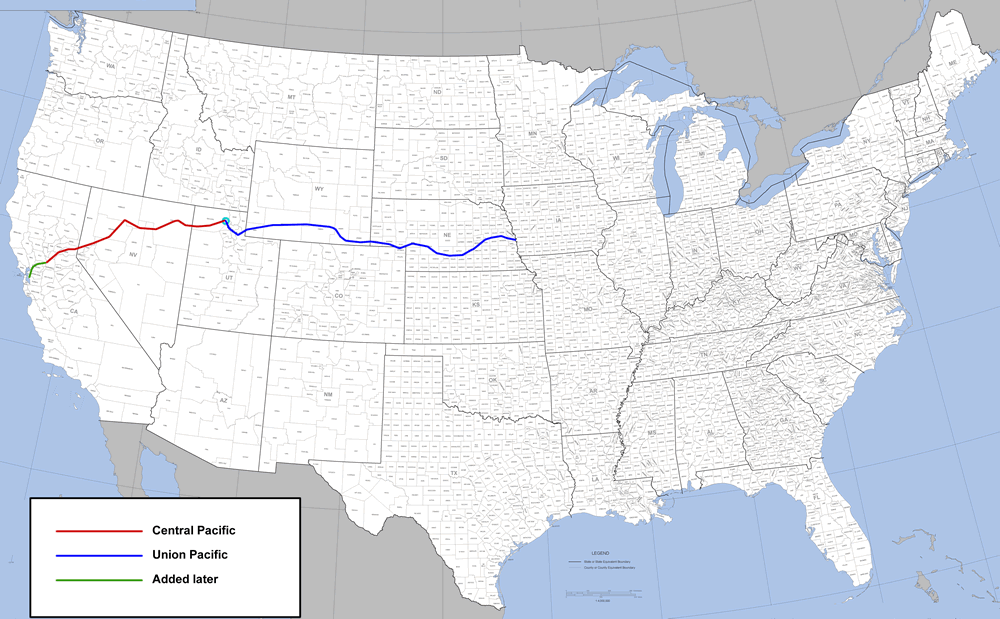 This evening I was writing a paper analyzing the social and economic effects of the completion of the transcontinental railroad in the west (which, might I add, are nearly endless.) Fun, right? In the event that you don't know what the transcontinental railroad is I have included a little map to the right >
Anyway, as I was writing my essay on a topic that I have absolutely no interest in, it occurred to me that I still might actually learn something useful from this class after all. Surely if the class is required--or at least recommended--there is probably a reason for it. And even if, at the end of the class, I don't get anything substantial out if it involving the content of the class, simply to learn under a teacher--some of the most dedicated and wise people that I have met--is enough to never regret any class that I have taken.
I am not by any means saying that the time that you spend in your math or science or history or English classes is time that is not well spent, although it may seem like it in the moment. What I am saying is that, although you may not ever find a use for the endless amounts of useless knowledge that you gain in these classes, some things that you learn in school you will carry with you for the rest of your life.
This evening I was writing a paper analyzing the social and economic effects of the completion of the transcontinental railroad in the west (which, might I add, are nearly endless.) Fun, right? In the event that you don't know what the transcontinental railroad is I have included a little map to the right >Anyway, as I was writing my essay on a topic that I have absolutely no interest in, it occurred to me that I still might actually learn something useful from this class after all. Surely if the class is required--or at least recommended--there is probably a reason for it. And even if, at the end of the class, I don't get anything substantial out if it involving the content of the class, simply to learn under a teacher--some of the most dedicated and wise people that I have met--is enough to never regret any class that I have taken.
18 January 2011
On the Sword and the Pen: Part II
As a follow up to my first post, I wanted to further elaborate on the reasons I chose the name The Sword and the Pen for this project. The answer comes in two parts.
Part 1: The first reason that I chose this for the title comes from the famous line from act II of a play by Edward Bulwer-Lytton called Richelieu. Essentially, the main character, Cardinal Richelieu, who is a priest, discovers that his friend Joseph the monk is planning some plot against him. Being a priest, he is prevented from engaging in a physical fight. At this point he utters the famous line,

.jpg) |
| ^ Cardinal Richelieu ^ |
Part 1: The first reason that I chose this for the title comes from the famous line from act II of a play by Edward Bulwer-Lytton called Richelieu. Essentially, the main character, Cardinal Richelieu, who is a priest, discovers that his friend Joseph the monk is planning some plot against him. Being a priest, he is prevented from engaging in a physical fight. At this point he utters the famous line,
Beneath the rule of men entirely great,
The pen is mightier than the sword.
Although Edward Bulwer-Lytton is often given all of the fame for having thought up this brilliant line, he is hardly the first one to have the thought. Awesome people like Shakespeare, Thomas Paine, Thomas Jefferson, and Robert Burton all had similar thoughts. Although the prize goes to a Greek poet named Euripides whose dying words were
The tongue is mightier than the blade.
Part 2: The second reason comes from the brilliant singer/song writer Regina Spektor's song "Sword and Pen" from her album, Far. This song, like most of hers, can have a million different meanings. For me it signifies the importance of thinking critically about how our world functions. What if we got it wrong? What if the sword kills the pen?
If you don't know who these two people are, you should definitely google them--or bing them, if you roll that way--and learn everything you can about them. Edward Bulwer-Lytton was an amazing writer whose words are still used in conversations today, and Regina Spektor is a brilliant song writer whose lyrics are beautiful and meaningful and will be remembered (at least by me) for long after she stops writing.
Subscribe to:
Posts (Atom)